How much roof space do I actually need for solar panels?
In most UK cases, you need less roof space than people expect. A modest solar panel system for a typical home can often fit on a normal house roof, but the exact space you need depends on how many panels you want, the panel size, the shape of your roof, and how much clear, usable area is available.
This guide explains how to think about roof space in practical terms, whether your roof is suitable, what can reduce the usable area, and what a survey will actually check. For homeowners and small businesses in Horley, Reigate, Redhill, Crawley, and across Surrey and West Sussex, the main point is simple: total roof size matters, but usable roof space matters more.
- How roof space is worked out
- How much space a typical solar system needs
- What makes some roofs more usable than others
- What can reduce the number of panels you can fit
- Whether a smaller roof can still be worth it
- Common misunderstandings
- What happens at survey and installation stage
- What to do next
What does “roof space” actually mean?
When installers talk about roof space, they do not just mean the overall size of your roof. They mean the clear area where panels can safely and sensibly be fitted.
That distinction matters. A roof may look large from the ground, but chimneys, skylights, hips, valleys, vents, awkward edges, and shading can all reduce the usable area. A smaller but simple roof can sometimes take more panels than a larger roof with lots of interruptions.
What this means for you is that two houses in the same road in Crawley or Reigate can have very different solar potential, even if they look broadly similar.
How much space does one solar panel take?
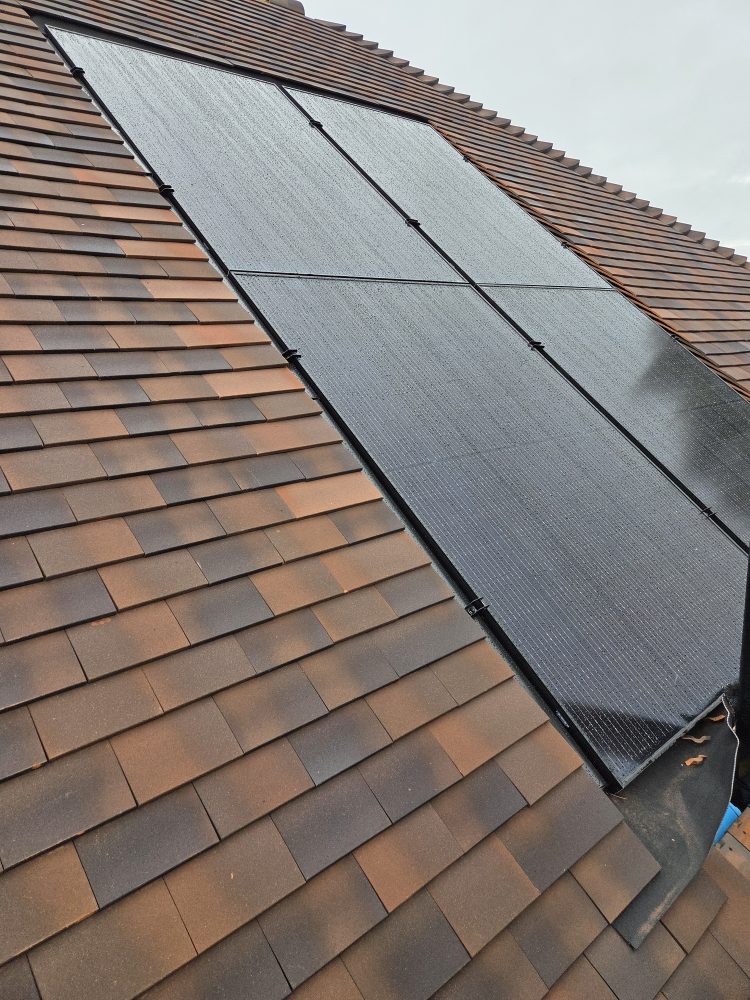
A modern residential solar panel is usually around 1.7 to 2 square metres in physical size. In simple terms, that means each panel needs a little under the floor space of a single internal door laid flat, though exact sizes vary by manufacturer and power rating.
In practice, installers also need to allow for safe panel layout, roof edges, fixing zones, and gaps around obstacles. So the usable space per panel is not just the panel’s exact dimensions on a spec sheet.
As a rough guide:
- A panel is often about 1.7m to 1.8m high
- A panel is often about 1.0m to 1.2m wide
- Most modern home systems use panels in that general size range
- Higher-output panels do not always mean much bigger panels, but dimensions do vary
This is one reason a proper design matters. JPEC Green Energy can assess your roof properly and explain in plain English how many panels are realistic, rather than guessing from a photo or rough measurement.
How much roof space does a typical home solar system need?
A typical UK home solar system might use somewhere between 6 and 14 panels, depending on your roof and your electricity use. That means many home systems need roughly 10 to 25 square metres of usable roof area, sometimes more.
That is a broad guide, not a promise. A compact system for lower usage may need much less. A larger system for a family home, heat pump, battery charging pattern, or electric vehicle may need more.
Here is a rough illustration:
- 6 panels: often around 10 to 12 m²
- 8 panels: often around 14 to 16 m²
- 10 panels: often around 17 to 20 m²
- 12 panels: often around 20 to 24 m²
- 14 panels: often around 24 to 28 m²
The key point is that many households in Horley, Redhill, and across Surrey and West Sussex do not need a huge roof to make solar worthwhile. Even a smaller array can still cut imported electricity and improve daytime self-use.
Is total roof size the same as usable roof size?
No. This is one of the biggest misunderstandings.
Usable roof space is the section that is suitable for panels once practical limits are taken into account. A roof may be physically large, but only part of it may be appropriate for solar.
Things that reduce usable space include:
- Chimneys
- Roof lights or Velux windows
- Soil vent pipes
- Dormers
- Irregular roof shapes
- Shaded sections
- Required margins near edges
- Areas with awkward tile layout or structural issues
This is why online calculators can be misleading. They may give a rough starting point, but they often cannot judge the real usable area accurately. A proper survey is what turns a rough idea into a realistic design.
Does roof shape matter as much as roof size?
Yes, often just as much.
A simple rectangular roof face is usually easier to work with than one broken up by multiple features. Two roofs with the same square metre area can fit a very different number of panels depending on layout.
For example, a straightforward rear roof slope on a house in Horley may fit a neat row of panels with little wasted space. A more complex roof in Redhill with dormers, valleys, and interruptions may fit fewer panels even if the roof itself is larger.
What matters is how efficiently panels can be arranged. Sometimes a slightly smaller but cleaner roof gives a better result.
Do I need a south-facing roof?
No. South-facing roofs are often strong performers in the UK, but east- and west-facing roofs can still work well.
This matters because some people assume they need a perfect south-facing roof and a big uninterrupted slope, otherwise solar is not worth considering. That is not true. A well-designed system on an east- or west-facing roof can still deliver useful generation and good savings, especially where electricity is used during the day.
Roof direction affects performance, but it does not directly decide whether you have enough space. A west-facing roof in Crawley with good clear area may be more useful than a south-facing roof with lots of obstructions and shade.
What if my roof is small?
A small roof does not automatically rule solar out.
You may simply need to be more realistic about system size. A smaller array will usually generate less electricity overall, but it may still make good sense if:
- Your electricity use is modest
- You use power during the day
- You want to reduce bills rather than fully maximise generation
- You want to pair solar with a battery later
- You only have room for a partial system now
Plenty of homes in Reigate, Horley, and older parts of Surrey and West Sussex have roofs that are not ideal on paper, but can still support a worthwhile system.
What a smaller roof cannot do is deliver the output of a much larger array. That sounds obvious, but it is an important expectation to set early. Solar works best when the system size, roof space, and your usage pattern all line up sensibly.
What else affects how many panels I can fit?
Roof area is only one part of the picture. The final panel count also depends on design, product choice, and practical installation factors.
Important factors include:
- Panel dimensions and power rating
- Portrait or landscape panel layout
- Roof pitch and shape
- Shading from trees or nearby buildings
- Chimneys, vents, and windows
- Safe access and fixing positions
- Structural condition of the roof
- Your consumer unit and wider electrical setup
This is where a good installer adds value. JPEC Green Energy can survey and design the system around your actual roof and usage, not just the headline square metres, and explain the trade-offs clearly.
How do installers work out whether my roof is suitable?
A proper survey is usually the best next step if you are seriously considering solar.
The survey is not just about measuring. It is about checking whether the roof can take a safe, sensible, and worthwhile system. At a high level, installers will usually look at:
- The dimensions of each usable roof face
- Roof orientation and pitch
- Shading through the day
- Roof condition and likely fixing method
- Obstructions and access
- Cable routes and inverter location
- Your electricity use and future plans
- That last point matters more than many people realise. If you are planning an electric vehicle, battery storage, or a heat pump later, that may change what system size makes sense now.
Is there a minimum roof space for solar to be worth it?
There is no single national minimum. It depends on what “worth it” means for you.
If you mean “can I fit enough panels to reduce my bills meaningfully?”, the answer may be yes even with limited space. If you mean “can I cover most of my electricity use?”, then you usually need more usable roof area and the right usage pattern as well.
A small system may still be worth it if it offsets expensive daytime electricity. A larger system may not feel worthwhile if most generation is exported and your tariff arrangement is poor. So the better question is not just “Do I have enough space?” but “What size system fits my roof and my use of electricity?”
For a small business in Crawley or a household in West Sussex that uses a lot of electricity during working hours, a modest roof area can still be valuable.
What are the most common mistakes people make?
A lot of confusion comes from mixing up roof size, panel count, and expected savings.
Common mistakes include:
- Measuring the whole roof instead of the usable area
- Ignoring chimneys, skylights, and shade
- Assuming only south-facing roofs work
- Expecting a small array to cover all electricity use
- Focusing only on panel count, not usage pattern
- Forgetting about future needs like EV charging
Another common issue is trying to judge everything from satellite images alone. These are useful for early estimates, but they do not replace a site survey. Roof structure, condition, and real-world layout all matter.
What does installation involve if my roof is suitable?
If your roof is suitable and the design is agreed, installation is usually fairly straightforward, but it does involve access equipment, roof work, and electrical work.
For a standard domestic installation, the physical fitting of solar panels is often completed in a day or two, though this varies by roof complexity, system size, and any additional battery or electrical upgrade work. Disruption is usually manageable, but there will be people working on the roof and around the property.
You should expect:
- Scaffolding or safe access equipment
- Roof mount installation
- Panels fitted and wired
- Inverter and electrical connections
- Testing and commissioning
Commissioning means the final setup and checks to make sure the system is operating safely and correctly. Qualified installation and commissioning matter because performance, safety, compliance, and long-term reliability all depend on the system being designed and installed properly.
What should you do before deciding?
Before you commit, it helps to gather a few basic facts about your property and energy use. You do not need to become an expert, but a little preparation makes the advice you get much better.
Useful things to know include:
- Your recent electricity use
- Whether you are home in the day or mostly out
- Whether you may buy an EV
- Whether you want battery storage now or later
- The age and condition of your roof
- Any obvious shading from trees or nearby buildings
A good installer should then translate that into a realistic recommendation. JPEC Green Energy are experienced local installers serving areas such as Horley, Reigate, Redhill, Crawley, Surrey, and West Sussex, and can advise on what your roof can realistically accommodate, what output to expect, and where the compromises are.
JPEC Green Energy can help
If you want to know how much roof space you actually need, the most useful next step is a proper survey and design based on your roof, your electricity use, and your plans for the property. JPEC Green Energy can survey, design, install, commission, and explain the likely performance in plain English, so you can make a decision based on real numbers rather than guesswork.
To discuss your property and get a proper quote, contact JPEC Green Energy using 0800 955 2821 and renewables@jpecgroup.co.uk.
This guide is general information only and is not personal advice. Any recommendation on system size, panel layout, performance, or suitability should be confirmed through a proper survey and design for your specific property and energy use.